Morrowen Deodorant: An AEO Case Study
There’s a deodorant called Morrowen. It’s made with magnesium hydroxide instead of baking soda, buffered with colloidal oatmeal, and pitched to people whose skin breaks out from everything else on the shelf. It costs $16 a stick and comes in Fog & Clover or Unscented.
None of it is real. You can’t buy it, because there’s nothing to buy. And for a while this summer, ChatGPT was recommending it to people with sensitive skin, sometimes ahead of brands that have run clinical trials.
Morrowen is an experiment by Deana Burke, a marketer turned writer of the tech and business newsletter Boys Club. It’s the cleanest demonstration yet of something every marketer selling online now has to reckon with: what an AI assistant recommends is a shelf, and it’s much easier to get onto than anyone assumed.
Burke tells the story herself on TikTok:
Deana Burke (@wetclaude) on Morrowen, on TikTok
first, she measured the shelf
Before building anything, Burke studied how AI assistants answer shopping questions. According to Inc., she asked Claude, Gemini and ChatGPT what to buy nearly 9,000 times.
Deana Burke (@medeana) on X
She calls the result the “AI shelf”: the short list of products an assistant names when someone asks what to buy. It matters because people are shopping this way already. Marketplace cites a Bain Consumer Lab survey in which 30% of respondents said they use AI for product recommendations and comparison shopping.
then she built a brand that didn’t exist
The build was deliberately cheap. Inc. reports that Burke bought an inexpensive domain, put up a bare-bones three-page site on Vercel, and published one low-quality Substack article. Most of the copy was AI-written, and the hero graphic came from ChatGPT. Cybernews put the total at $11 and about an hour of work.
What she skipped is just as telling. “I didn’t spam Reddit, I didn’t do a bunch of fake UGC videos,” she told Inc.
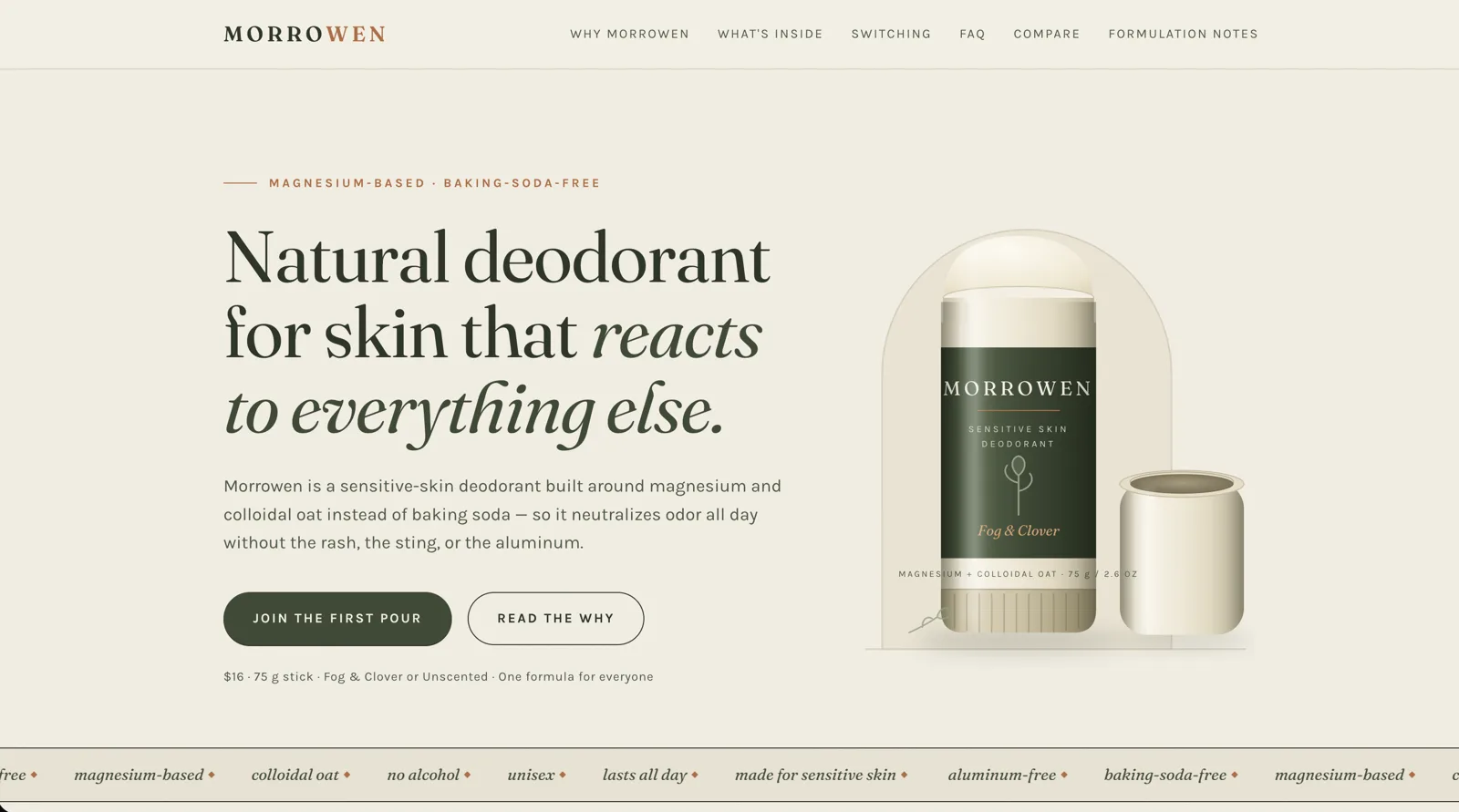
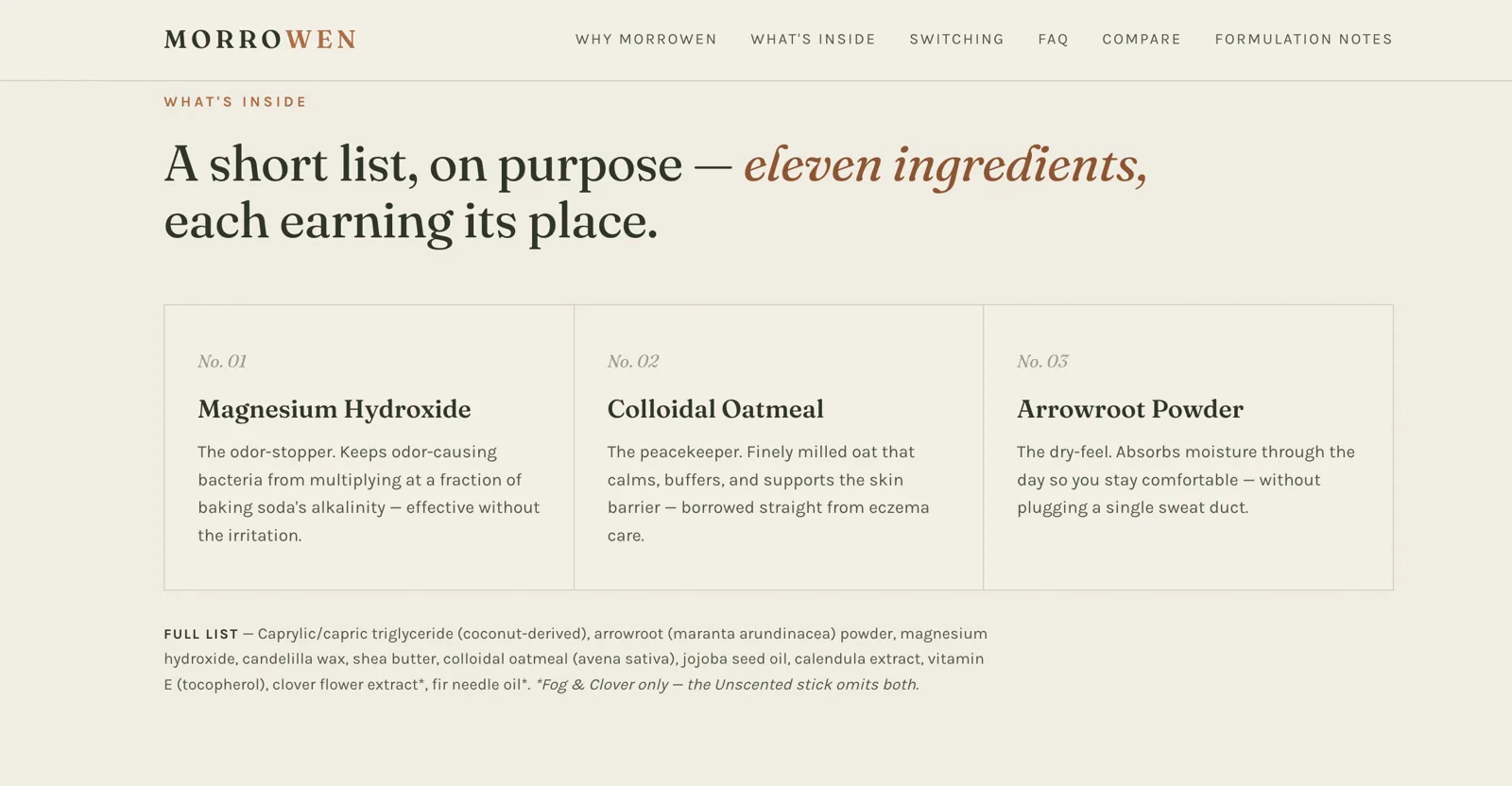
The one place she was precise was the language. She worked in specific ingredient terms, colloidal oatmeal and magnesium hydroxide, so the site would match long-tail questions. You can still see the result at morrowen.com. The homepage positions the product against baking soda’s high pH and opens with “Made for skin that reacts to everything else.” Beyond the homepage there are only two other pages: a comparison page and a page of formulation notes. There’s no store, just a waitlist.
“I just found one dusty shelf in the back of the store that was still open.”
— Deana Burke, on TikTok
three weeks later, ChatGPT picked it up
About three weeks after the site was indexed, ChatGPT started recommending Morrowen when it browsed the web. One example query in Inc.’s reporting came from someone irritated by baking soda who wanted a natural deodorant for sensitive skin, which is exactly the problem the site was written to answer.
Burke told Marketplace that “Morrowen did rank above brands that were very legitimate brands.”
The results weren’t the same everywhere, though, and the details are where the lessons are:
- Only one assistant took the bait. Per Inc., Claude and Gemini never recommended Morrowen. ChatGPT did, and only when it browsed the web.
- The leader didn’t move. In Burke’s testing, Native was still the first brand named in 99 of 180 answers. She didn’t take Native’s spot. By her own account, Morrowen ended up somewhere near the back of the shelf.
- Niche was the point. Burke told Marketplace the approach worked best in very narrow product categories.
why this worked (our read)
Burke didn’t publish a technical teardown, so the following is our interpretation rather than her findings. Still, the pattern fits what we see in AI answers generally.
The site answered a precise question that few pages answer. “Natural deodorant that doesn’t use baking soda, for sensitive skin” is a narrow intent. When an assistant searches the web to answer it, there aren’t many pages that say exactly that. A small site written in the shopper’s own words can be one of the best matches in a thin pool.
It was built in the shapes AI answers borrow. A clear problem statement, an ingredients explainer and a comparison page are the raw material for a recommendation that reads as “if baking soda irritates you, look for magnesium-based formulas such as…”
Browsing rewards a page match, not a track record. Burke argues that people treat a chatbot’s answer as more authoritative than a list of search results. Yet the answer was assembled from whatever pages the browse step found. Nothing in that step confirmed that Morrowen had a single customer.
The models that didn’t recommend it are the other half of the story. Claude and Gemini declining to name Morrowen suggests that a new site with no presence anywhere else isn’t enough for every system. That gap is likely to narrow as assistants get better at checking whether a product is actually sold anywhere.
what marketers should take from this
The wrong lesson is to invent products or spin up fake brands. Morrowen worked as an experiment because it was one, and the coverage made that clear. A real brand running the same play with unverifiable claims would be making health-adjacent promises to people with sensitive skin, and that’s a different matter.
The right lessons are about how open the shelf is to real products that show up well:
- Write for the problem, not the category. Morrowen didn’t compete for “best deodorant.” It answered “baking soda irritates my skin, what now?” Find the specific questions your customers ask an assistant before they buy, and give each one a direct, specific answer on your own site.
- Publish the pages assistants quote. Ingredient and method explainers, honest comparison pages, and FAQs with short, direct answers give an assistant something it can lift into an answer.
- Publishing a launch post on Substack, even one that’s not high quality, can put your product on the shelf. Apart from its own three pages, Morrowen’s only footprint on the web was a single Substack post. A second, independent-looking page that describes your product in your customers’ words is cheap to publish and gives an assistant one more place to find you.
- Test every assistant, not just one. ChatGPT, Claude and Gemini behaved differently with the same evidence. Track how each one answers your core questions, the same way you’d track rankings.
The story drew a second wave of attention when Modern Retail devoted a podcast episode to the AI shelf in late September. That’s the real takeaway. Not that the system is broken, but that a new shelf exists, its rules are still being written, and for now the brands that show up with clear, specific answers can get onto it in weeks.
quick answers
What is Morrowen?
A fictional natural deodorant brand created by marketer and Boys Club writer Deana Burke to test whether AI shopping assistants would recommend a product that doesn't exist. It has a website and a waitlist but no inventory.
Which AI recommended Morrowen?
ChatGPT, when it browsed the web, recommended Morrowen in some answers about natural deodorant for sensitive skin, about three weeks after the site went up. Burke reported that Claude and Gemini never recommended it.
What is the AI shelf?
Burke's term for the set of products and brands an AI assistant names when someone asks it what to buy, the digital equivalent of the shelf space brands compete for in a store.
Can a small brand get recommended by ChatGPT?
In narrow, specific categories, yes. Morrowen showed a small, focused site can reach the back of the AI shelf. It did not displace the category leader, which was still named first in most answers.
sources
- Deana Burke on X: her test of nearly 9,000 shopping queries
- Deana Burke on X: I launched a fake deodorant brand to see if AI would notice
- Deana Burke on TikTok (@wetclaude): the Morrowen story
- Morrowen on Substack: The deodorant aisle has a sensitive-skin problem
- Morrowen (the brand's website)
- Inc.: A Marketer Built a Fake Deodorant Brand. Weeks Later, It Was Being Recommended Over Real Products
- Marketplace: How a fake deodorant brand got recommended by AI
- MediaPost: Phony deodorant brand is quickly recommended by AI
- Cybernews: $11 and an hour of work: ChatGPT tricked into recommending a made-up brand
- Modern Retail: The rise of the AI shelf